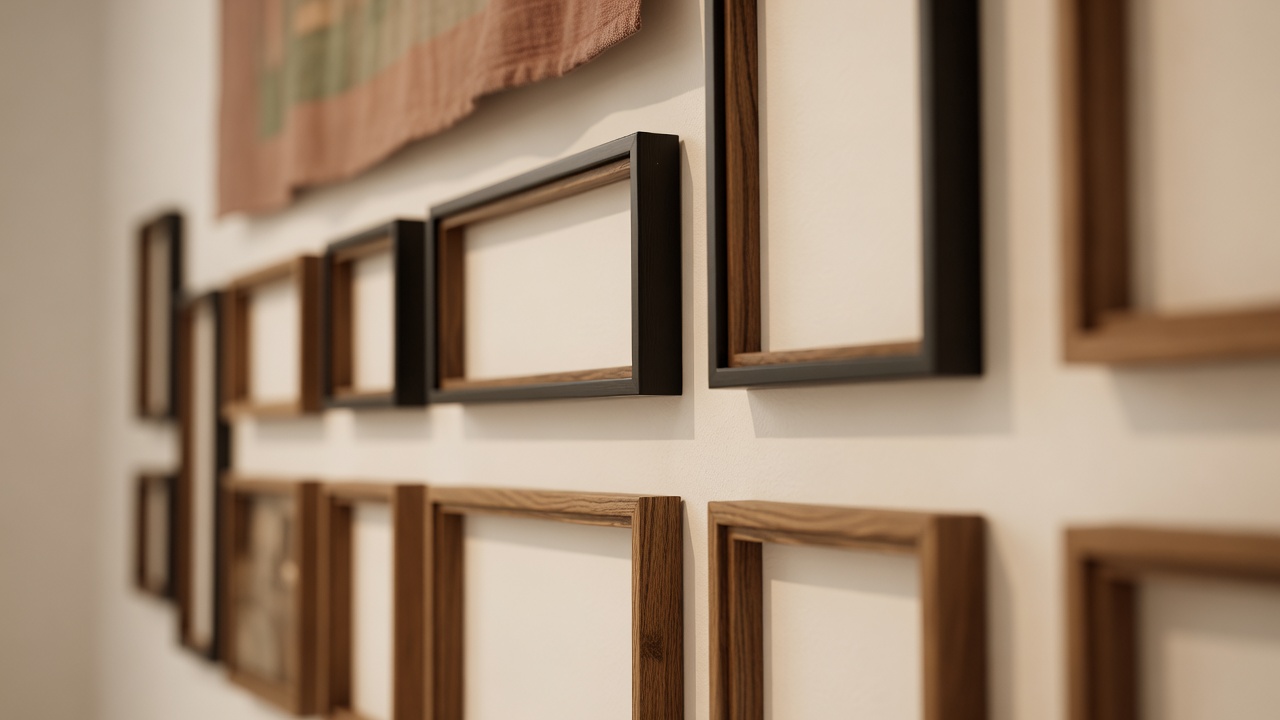
Start with what the pictures share
Most picture walls fail not because of measurements but because the pieces have nothing to say to each other. Before arranging anything, lay your candidates on the floor and look for the thread: the same holiday, the same palette, the same hand, the same kind of light. You do not need everything to match. You need enough repetition – a recurring colour, frame finish or subject – that a visitor senses a group rather than a pile.
It helps to name the group in a few words, as if writing a tiny exhibition title: "Summers at the lake", "Drawings by my mother", "Black-and-white streets". Anything that does not fit the sentence can wait for the next rotation. This one habit removes most of the agonising later.
Find the centre line
Many galleries hang work so its centre sits around 145–152 cm from the floor, roughly average eye level. The National Gallery in London and many smaller museums use a similar band, and it translates well to homes. For a group, treat the whole arrangement as one picture and put its centre on that line. Above furniture, the furniture takes priority: keep the lowest frame 20–25 cm above a sofa back or sideboard so the two feel connected rather than floating apart.
In rooms where you mostly sit – a dining room, a reading corner – you can lower the line by 10 cm or so. Homes are lived in at different heights, and a wall that looks right from your favourite chair is a good wall.
Choose a structure
The grid
Identical frames, identical gaps. Calm and modern; ideal for a photo series or botanical prints.
The salon hang
Mixed sizes clustered tightly, a style made famous by the Paris Salon and still seen in the Royal Academy Summer Exhibition. Anchor it with one larger piece slightly off-centre.
The shared line
All frames align along one top or bottom edge. Excellent in corridors and above long furniture.
The ledge
A narrow shelf where frames lean and overlap. No new holes when you change your mind – perfect for rentals.
Plan on paper, then on the wall
Trace each frame onto kraft paper, cut the shapes out and mark the hanging point on each template. Tape them to the wall with low-tack painter's tape and live with the layout for a day or two. Move pieces until the visual weight feels even: darker or larger frames feel heavier, so balance them diagonally rather than stacking them on one side. Sir John Soane, whose London house-museum is a masterclass in dense arrangement, worked in a similar spirit, constantly revising his walls rather than fixing them once.
Keep the gaps consistent – 5 cm for small frames, up to 8 cm for larger ones. Irregular gaps are what make most walls look accidental.
Hanging hardware and gentle care
Use two hooks per frame wherever possible; frames stay level and spread the load. D-rings screwed into the frame back are steadier than wire. Check your wall type: plaster and plasterboard need appropriate anchors, while picture rails and cords avoid holes entirely. For photographs and works on paper, ask for acid-free mounts and UV-filtering glazing, and avoid walls that catch direct sunlight. Bathrooms and the wall above a radiator are poor homes for anything you care about.
Plan your first display in an afternoon
- Choose one wall you see every day and measure its width and the furniture beneath it.
- Gather five to nine pieces that share a story, and lay them on the floor in your chosen structure.
- Photograph the floor layout so you can return to it.
- Make paper templates, tape them up at a 145 cm centre and adjust for a day.
- Hang the central or largest piece first, then work outwards, checking gaps with a spacer block.
- Add one paper label or a short note nearby, and set a reminder to rotate in three months.
Let it change with you
The most personal walls are never finished. Jim Ede's Kettle's Yard in Cambridge still feels like a home because its pictures sit among stones, chairs and daylight, not behind ropes. Leave a little room in your arrangement for new arrivals and do not be afraid to take something down when it no longer speaks to you.