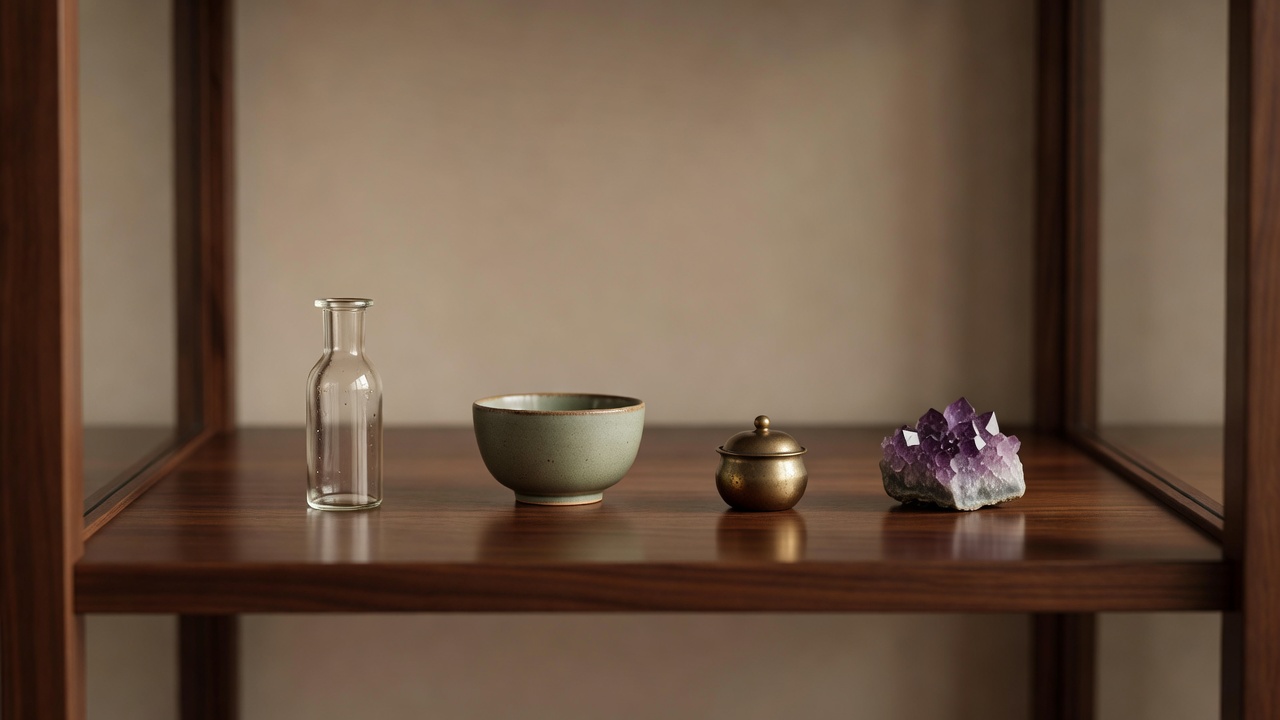
Begin with why you keep them
Collections grow for many reasons: a lifelong curiosity, a family inheritance, a habit of bringing something home from every trip. The display should reflect that reason. A scholarly collector of studio pottery may want pieces grouped by maker; someone keeping a late parent's figurines may want them where coffee is made each morning. Neither is wrong. Decide what you want to feel when you look at the shelf, then arrange for that feeling.
The historical cabinet of curiosities – the Wunderkammer, illustrated famously in Ole Worm's 1655 Museum Wormianum – crammed every surface. It is a lovely image but a tiring way to live. Today, a little restraint lets your best pieces lead.
Group, lead, repeat
Build small triangles
Three objects of different heights form a stable, readable shape. Repeat the triangle along the shelf rather than lining things up like soldiers.
Let one piece lead
Every cluster needs a star – the largest, oldest or most loved object – with quieter companions around it.
Repeat a colour or material
A thread of brass or one glaze colour across several shelves ties a whole bookcase together.
Use risers and bases
A small block, a stack of books or a simple plinth lifts tiny objects into view and creates layers.
Working dimensions
| Shelf or surface | Size | Suggested arrangement |
|---|---|---|
| Floating shelf | 60 × 20 cm | One cluster of 3, plus empty space at one end. |
| Bookcase bay | 80 × 30 cm | Books on one side, objects in 1–2 groups on the other. |
| Glass cabinet shelf | 90 × 35 cm | Two staggered rows, smaller pieces in front on risers. |
| Console table | 120 × 35 cm | Tall piece at one end, low group at the other, a tray to unite small items. |
Open shelves or closed cabinets?
Open shelves feel friendly and invite handling, but they collect dust and offer no protection from curious pets or children. Glass-fronted cabinets – the approach Isabella Stewart Gardner used for many smaller treasures in her Boston home-turned-museum – keep dust off and slow humidity changes. A good compromise is to keep sturdy pieces on open shelves and fragile or valuable items behind glass. Inside cabinets, keep objects a few centimetres from the glass so reflections stay clean and doors close safely.
Secure, but reversibly
Museum wax or putty holds small objects steady against knocks and vibration and can be removed later. Anchor tall bookcases to the wall. Avoid strong adhesives, which can mark glazes and lift paint. Place heavy pieces on lower shelves.
Care by material
Ceramics and glass
Paper, books and ephemera
Textiles
Metal, coins and minerals
Toys, figures and vinyl
Leave room for the next find
Collections are rarely finished. Keep a little empty space on purpose and a small storage box for pieces waiting their turn. Rotating objects in and out – the subject of our interactive ideas page – keeps the display fresh and reduces the light and dust any single piece receives.